← All recipes
Sourdough Pizza Romana
Steps
- Mix the dough (10:00 a.m., or when your sourdough starter is ripe)
- Add the flour, salt, water, and ripe sourdough starter to the bowl of a stand mixer fitted with the dough hook attachment. Turn the mixer on to speed 1 (STIR on a KitchenAid) for 1 to 2 minutes until everything is incorporated. Then, turn the mixer up to speed 2 and mix for 2 to 3 minutes until the dough starts to cling to the dough hook. Let the dough rest for 5 minutes.
- Add the extra-virgin olive oil to the dough in the mixing bowl and turn the mixer on to speed 1 for 1 to 2 minutes until the olive oil is completely absorbed into the dough. Turn the mixer up to speed 2 and mix for an additional 2 minutes until the dough is further strengthened and begins to smooth out and cling to the dough hook. This dough is soft and won’t completely come away from the sides of the mixing bowl. Transfer the dough to another bowl or container for bulk fermentation.
- Bulk ferment the dough (10:30 a.m. to 2:00 p.m.)
- Cover the dough and let it rise at room temperature (72 to 74°F) for a total of three and a half hours. You’ll give the dough three sets of “stretch and folds” to impart additional strength during this time. Set a timer for 30 minutes and let the dough rest, covered. After 30 minutes, give the dough its first set of stretch and folds.
- Use slightly wet hands to grab the dough farthest from you in the container for each set, stretch it up and over to the side nearest you. Then, grab the dough on the side closest to you and stretch it back up and over to the farthest side of the container. Repeat two more folds, one at the right side of the container and one at the left—you’ll now have a folded up square in the container. Let the dough rest, again covered and at room temperature, for 30 minutes, stretching and folding again. Repeat this process one more time for three total sets. After the third set, let the dough rest, covered, for the remaining time in bulk fermentation.
- Refrigerate the dough (2:00 p.m.)
- After three and a half hours, your dough should have smoothed out and risen in the bulk fermentation container. You might see a bubble or two on the surface or at the sides, and the dough should feel stronger, more elastic. At this point, you have a choice: proof the dough on the counter to be ready for baking in about 2 hours, or place the bulk fermentation container, covered, into the refrigerator.
- Place the container into the refrigerator, covered.
- Proof the dough (4:30 p.m. to 6:30 p.m. the same day, or anytime up to 4:30 p.m. the next day)
- About 2 hours before you’re ready to bake the pizza, remove the bulk fermentation container from the fridge and place it on your kitchen counter. Let it warm up and come back up to room temperature for one hour.
- After the dough has been out for an hour, start preheating your oven, with an oven rack in the middle, preferably holding a Baking Steel or baking stone, to 500°F (260°C).
- At this time, also prepare any toppings for your pizza. To make the tomato sauce, add the ingredients to a blender, and blend until smooth.
- Shape the pizza (6:30 p.m.)
- After about an hour, once your baking surface in the oven is fully preheated, prepare your sheet pan t. Using a pastry brush, brush a very light coating of olive oil onto the pan, edge to edge. It’s important not to spread too much oil here—just enough to ensure the dough doesn’t stick.
- Uncover your dough, lightly flour the top, and scrape it out onto a floured work surface. Lightly flour the top of the dough that’s now facing up, and using floured hands, gently press the dough out into a rectangle shape. Once you’ve pressed the dough out to about ¾ the length of the pan, transfer it to the pan by dragging it over its edge. Alternatively, you can use a thin cutting board or pizza peel to slide under the dough and then remove it from the peel to the pan. Once the dough is in the pan, finish shaping by pressing it out and reaching under the sides to stretch it to fit the pan gently.
- Top and bake the pizza (6:45 p.m.)
- First, bake the pizza only topped with sauce to help the base get a head start before adding the cheese and other toppings. Using a large spoon, spread about ¼ to ½ cup tomato sauce onto the dough in an even, light layer (you’ll have some leftover tomato sauce, which is excellent for pasta!). Slide the baking sheet into the oven, turn the oven down to 425°F (220°C), and bake for 10 minutes.
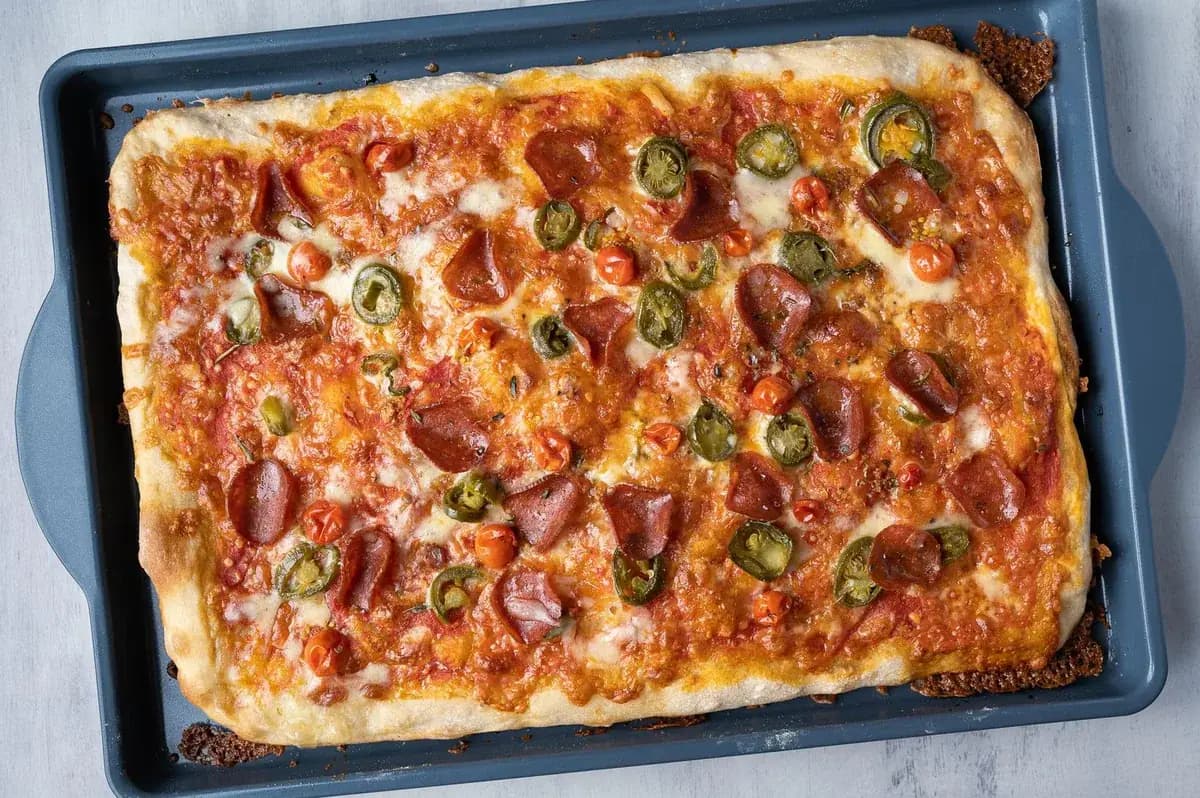
- After 10 minutes, use oven mitts to remove the baking sheet to a wire rack. Spread on your remaining toppings: shredded mozzarella, pepperoni, olives, etc. Slide the baking sheet back into the oven and bake for an additional 15 to 20 minutes until the cheese is melted and the crust is well-colored. Use a pair of tongs to lift the pizza and check the underside; it should be browned and crispy. If the bottom is still underbaked, continue to bake the pizza for another 5 to 10 minutes.
- When finished baking, remove the pizza from the oven and let cool for 5 minutes before cutting.
Originally published at food52.com. Reproduced for personal collection.