← All recipes
Preserved Lemon Spatchcock Chicken over Potatoes
Steps
- Marinate. Blend or mash the preserved lemon, brine, chilis, garlic, olive oil, and pepper into a rough paste. Rub it over and under the skin of the spatchcocked chicken. Bag it or cover it and refrigerate at least 4 hours, ideally overnight.
- Scrape and dry. Take the bird out and wipe the surface clean of lemon rind and chili pieces. They scorch black over live fire, and you want them for the relish anyway. Save the solids. Then pat the skin bone dry with paper towels, both sides, more aggressively than feels polite. Wet skin steams instead of browning, and this is the single biggest thing standing between you and crisp.
- Set up the grill. Two outer burners on, center burner off. Lid down, bring it to 425°F. Confirm the lid closes over the warming rack with a flat bird on it before you commit dinner to this.
- Start the potatoes. Toss the halved potatoes with pepper only. Spray the cold cast iron skillet, add the potatoes cut-side down in a single layer, and set the skillet on the grate over the unlit center burner. Do not add fat to the potatoes. The chicken is about to give you plenty.
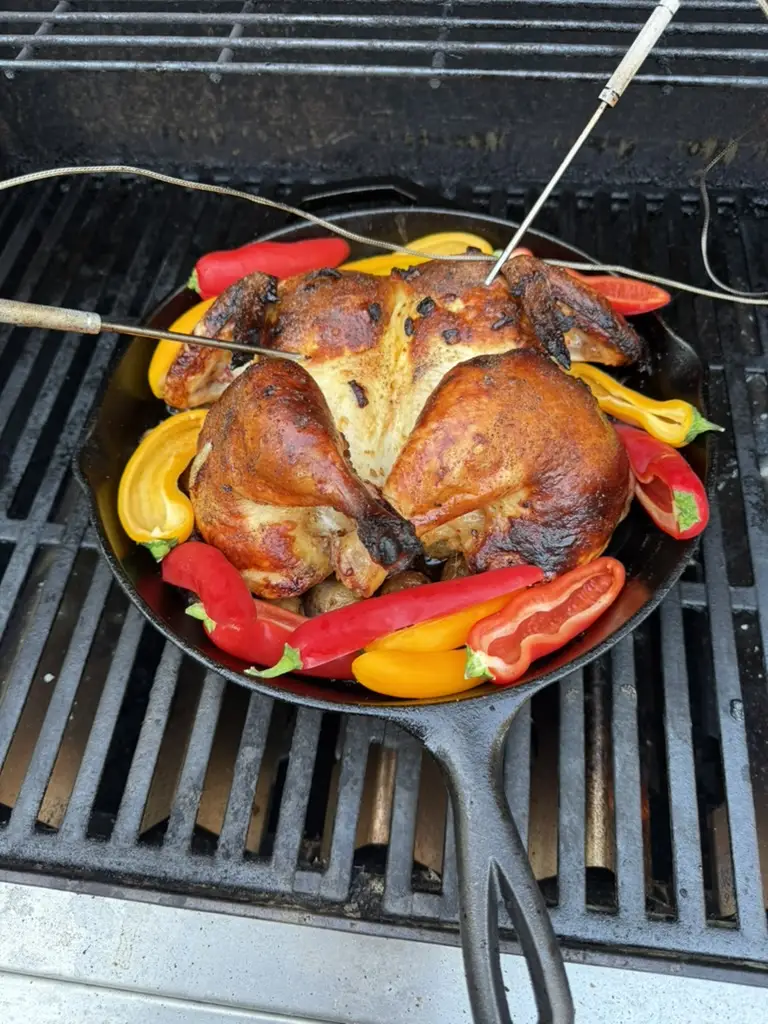
- Bird up top. Lay the chicken flat on the warming rack, skin side up, directly above the skillet. Lid down. Do not open it, do not flip, do not peek for 30 minutes. Every lift costs you five.
- Peppers in. At about 30 minutes, slide the snack peppers into the skillet around the potatoes. Lid back down.
- Temp it. Start checking at 40 minutes. Pull the chicken when the thickest part of the breast reads 155°F and the thigh reads 170°F to 175°F. Total time runs 45 to 55 minutes for a 4 lb bird.
- Rest on a rack. Move the chicken to a wire rack set over a sheet pan. Not a cutting board, not a platter. A resting bird throws off a startling amount of fat and juice, and skin that sits in that puddle goes soft in about five minutes. Do not tent it. It holds heat fine uncovered for 15 minutes.
- Crisp the potatoes. Pour the excess fat out of the skillet into a jar. You want the potatoes glossy, not swimming. Set the skillet over a lit burner on medium-high and let it go 10 to 12 minutes, undisturbed for the first half, tossing once. This is the step that turns soft potatoes into crunchy ones. Do not shortchange it.
- Relish and carve. Chop the reserved marinade solids with the olive oil, parsley, and a squeeze of lemon. Carve the chicken, pile it over the potatoes and peppers, spoon the relish across the top, and finish with flaky salt.
Notes
- Do not salt the birdTwo preserved lemons carry enough salt for a whole chicken. Adding more is the one way to ruin this.
- The jar of poured-off fat is schmaltzKeep it in the fridge and roast potatoes in it next week.
- The one-pan versionYou can put the chicken directly into the skillet on top of the potatoes, and it is genuinely delicious. It is also a trade: the skillet walls trap steam around the lower third of the bird, so the top of the skin bronzes beautifully and the sides stay pale and unrendered. Take that trade knowingly, or use the rack.
- Halve the peppersWhole snack peppers stay raw in the middle and dump water into the pan. Split them lengthwise.
- No warming rack?Run the chicken directly on the grate over the unlit center burner and cook the potatoes in the skillet over a lit outer burner instead. You lose the drippings, so finish the potatoes with a spoonful of the poured-off fat at the end.